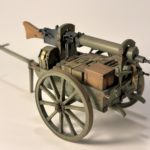

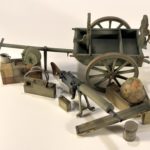
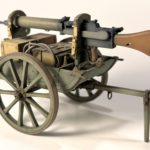
German Machine Gun 08/15 Set
- Scale / Maßstab: 1/16th (120mm)
- Material: Resin
- Parts / Teile: 46
- Infosheet / Infoblatt: English
- Code / Artikel-Nr.: 40MGW
- Attention: Not a toy. Model kit or model making accessories – not suitable for children under 14 years of age. / Achtung: Kein Spielzeug. Modellbauzubehör – nicht für Kinder unter 14 Jahren geeignet
GPSR Data / Angaben
- Manufacturer / Hersteller: Jon Smith Modellbau
- Responsible Person / Verantwortliche Person
- Address: Hannoverstr. 68, 29664 Walsrode, Germany
- Contact / Kontakt: info@jonsmith-modellbau.com
- Tel: +49 (0)5161 8255
Contents MG Cart / Inhalt MG Karren:
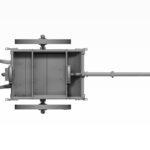
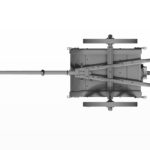
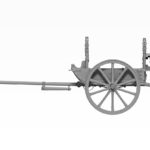
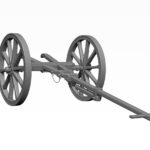
- Cart Body / Wagenkorpus
- 2 Wheels / 2 Wagenräder
- Undercarriage Assembly / Fahrwerk
- Pulling Shaft (2 parts) / Zugdeichsel (2 Teile)
- Leg Fixing Ring (plus 1 spare) / Stürzbeinbefestigungsring (plus 1 Ersatzteil)
- 2 Support Leg (for up or down pos.) / 2 Stützbeine (für oben oder unten Pos.)
- Front MG Support Post incl. Straps (6 parts) / Vordere MG-Stütze inkl. Gurte (6 Teile)
- Rear MG Support Post incl. Straps (7 parts) / Hintere MG-Stütze inkl. Gurte (7 Teile)
- 6 Corner Pulling Eyes (2 spare) / 6 Eck-Zugösen (2 Ersatzteile)
- Approx. 4 cm Mini-Brass Chain / Ca. 4 cm lange Mini-Messingkette
Contents MG 08/15 Set / Inhalt MG 08/15 Set:
- Machine Gun 08/15 (3 parts) / Maschinengewehr 08/15 (3 Teile)
- Standard MG 08/15 Bipod / MG08/15 Zweibein
- Double-Ended Spare Barrel Container for MG / Ersatzlaufbehälter für 2 MG Rohre
- Drum Magazine 16 / Trommelmagazine – Patronenkasten 16
- Drum Magazine Case / Trommelkiste für Patronenkasten 16
- 2 Wooden Ammunition Box M1901 / 2 Patronenkasten Holz M1901
- Water Container (2 parts) / Wasserkasten 15 (neuer Art) mit Ausgiesser (2 Teile)
- Steam Hose / Dampf-Schlauch
- Steel Helmet M.16 / Stahlhelm M.16
- German Gas Mask Tin M.16 (early version) / Bereitschaftsbüchse M.16 (alte Art)
- German Army Cup M.16 / deutsche Armmeetasse M.16
- Spare Parts for MG Assembly / Ersatzteile für MG
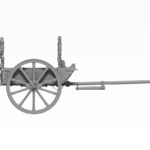
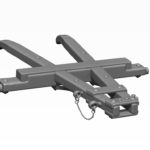
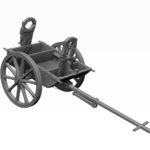
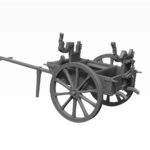
The photos below are snapshots from the 3D program used to create the master model:
Extracts from the Infosheet with this kit:
These simple wooden MG transport carts first appeared during the mid-war period (1916 onwards) and were used predominantly to transport the lighter of the German machine guns, the MG 08/15. Other uses of the cart included the transport of the heavier German MG 08, the Mauser 13mm Anti-Tank Rifle, general supplies, incl. ammunition or even the carrying of wounded personnel away from the immediate front-line areas (the rear MG support being used as a backrest for a sitting person, with legs each side of the second and front MG support).
The carts were also used on air bases to transport stores directly to the aircraft, including handheld bombs, hand grenades etc. The design of the air base versions had a simplified top corpus or body and no MG fixing supports, but seems to have an identical undercarriage assembly, wheels and pulling shaft.
By close examination of original photos, it is obvious that the carts were built to a set standard and allowed the issued ammunition boxes of the time to fit within the individual partitions of the main body (although I have come across different measurements during gathering of the reference material and preparing for the design), the front section being reserved for the double MG 08/15 drum magazine case. Some photo evidence indicates that the mounted MG could be brought into action whilst still fixed to the cart, the ammunition supply resting on the stowed equipment and cases etc.
It appears that the two protruding undercarriage parts at rear are in fact handles to enable the cart to be lifted up and over obstacles or in difficult terrain by an additional member of the MG team. An oddity on some original photos is the lack of the top hinged MG support clamps, presumably for an easier handling or removal (or the intention to carry the larger MG 08).
During the end of war period and the withdrawal of German troops from the Western Front, many of these carts were left behind in France and Belgium, which maybe the reason why the few existing examples are still to be found generally in these countries and mainly in private collections. There are also some film and photo images of these carts appearing in the unrests during 1919, generally in Berlin, employed by the various Freikorps units.
The after-war period and creation of the Reichswehr (1921 – 1935), saw a new designed MG Cart of a metal type, but principally doing the same job, i.e. transporting the heavy machine guns and there is little photo evidence of the wooden types being employed in any large numbers.
Late 1930s and through the removal of the pulling handle, wheels and axle, the cart could be turned into a sledge, which also appeared in smaller numbers during the Second World War, mainly on the Eastern Front. In most cases the MG attachment posts having been removed.
About this model
The wooden carts are now quite rare and seem to have been made to different specifications, which would indicate a number of firms being contracted to make them. They do though appear to have been well designed and made to a specific standard. On my own painted model version, I have added a support ring in front of the pulling slat. This does not appear on some of the original versions and hence was left off in my own design. This ring can though be easily made by thin metal foil or sculpturing putty.
There is also a choice of displaying the MG-Cart with open or closed support posts, hence the different types of fastening straps supplied with the kits.
Straps and Buckles
I have placed in small bags the straps, buckles and top parts with their associated MG-support posts as many of the pieces look similar. It is a good idea to keep these parts together until the final assembly.
The two MG supports in both the open and closed positions. Views are from the front and rear of cart:
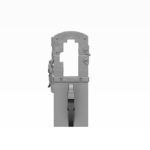
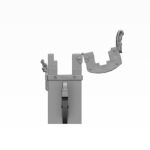
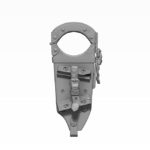
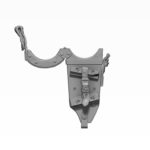
Both canvas and leather fastening straps were used to fix the wooden MG-support clamps or top-parts. It seems though that the majority of the photo material from WW1 show the canvas type straps and looper keeps (the small strap to hold the end in place) with steel buckles (frame), bar and prong, with reinforced metal (punch) holes.
The strap holes can be drilled out using 0,3 drill or less. Also, the resin webs inside the gaps, underneath and in between the buckles can be removed with a sharp modelling knife (a scalpel is ideal for this type of work).
The Straps
6 in total for the MG supports:
- 2 for the closed position MG-supports (these are longer, with both straps closed)
- 4 (2 pairs) for open position MG-supports
2 straps for the rear MG support bipod fixing position:
- 1 for the rear MG-support without bipod
- 1 for the rear MG-support with bipod fitted (this strap bulges out)
Painting the MG-Cart – my own thoughts
These carts would have been exposed to constant use in both the front- and rear-line areas and hence would show the signs of everyday wear and tear. Particularly any protruding or leading edges would be battered and worn, leaving exposed wood and metal areas. The wheels would pick up dirt etc. from the paths and roads, the locking pins, axel shaft and hubs would always have elements of oil and grease, mixed in with dirt showing on the paintwork. On the steel wheel rims I have added a slightly pitted or rough structure to the surface, copied from similar items seen on old wooden / metal farm machinery here in Northern German today.
On my own model I have used base coats of different lighter tones in Revell Enamels and after days of drying an overcoat and shading in Winsor & Newton oil paints, a technique I learned from a modelling friend over 30 years ago. The original paints used during the First World War were of cause not as long-lasting as we have today and little paintwork is left on these original carts seen today, which will generally have a light-grey appearance.
I will be uploading to the Jon Smith Modellbau website photos of old German agricultural machinery, which has been left out in the open for some length of time and exposed to the elements. Although the machinery is much younger (1950 – start of the 1970s), the appearance, particularly when wood and metal are fixed together is similar. Generally speaking, if untreated wood is left exposed to the sunlight (ultraviolet rays) then it will turn grey. The reason for this is the breakdown of the lignin, an organic polymer that, with cellulose gives the wood its structure and strength. Here one can see the rusted iron parts still attached and the different colours that these take on and give to the surrounding wood.
 An deutschsprachige Interessenten:
Sie können mich per eMail oder Telefon auch gerne auf deutsch kontaktieren. Ortsbesuch ist nach Absprache möglich.
An deutschsprachige Interessenten:
Sie können mich per eMail oder Telefon auch gerne auf deutsch kontaktieren. Ortsbesuch ist nach Absprache möglich.